
##Amarnath
##Dalhousie
##HimalayanTravel
##IndiaTravel2026
##Kashmir
##Ladakh
##Manali
##MountainTravel
##PilgrimageTourism
##Shimla
##TulipFestival
##VaishnoDevi
#The New Himalayan Trail 2026: Kashmir Ladakh Shimla Manali & Dalhousie Travel Guide
Somewhere Between the Tulips and the Snowline: North India Is Having a Moment
By: Magic Safari | Aug 2026
There’s a particular kind of traveller this year — the one who used to pick a single Himalayan destination and call it a holiday. In 2026, that traveller is disappearing. In their place: people stitching together tulip fields and mountain passes, pine forests and pilgrim trails, into one long, unhurried love letter to the north.
Every region has a season it’s known for. Ask a travel agent in February about Kashmir and they’ll talk snow. Ask about Ladakh in the same breath and they’ll tell you to wait until May. Ask about Amarnath any time outside July or August and you’ll get a polite “not this year.” For the longest time, that was the deal — North India handed you one door at a time, and you picked which one to walk through.
What’s changed in 2026 isn’t any single destination. It’s the space between them. Travellers are treating the whole northern arc — Kashmir’s lakes, Ladakh’s high desert, Himachal’s pine-covered ridgelines, the pilgrim roads to Vaishno Devi and Amarnath — less like a list of separate holidays and more like one long trail with several trailheads. Here’s what walking it actually looks like.
Kashmir: A Valley That Learned to Bloom Twice
Kashmir’s winter reputation needs no defending — the houseboats on Dal Lake, the gondola climbing toward Apharwat Peak, the particular hush that falls over Gulmarg after fresh snow. That story is intact and, if anything, more popular than ever with honeymooners chasing a candlelit dinner on the water or a photograph against a snow-white Gulmarg meadow.
But talk to anyone who’s visited in early April, and they’ll tell you about a different Kashmir entirely — one carpeted, almost implausibly, in tulips. The Indira Gandhi Memorial Tulip Garden in Srinagar, recognised as Asia’s largest, typically opens its gates in mid-to-late March and stays in bloom through most of April, with the garden at its most spectacular in the first two weeks of the month. Recent seasons have pulled in more than eight lakh visitors across the roughly month-long window, with single-day crowds topping 80,000 — numbers that rival India’s biggest cultural festivals, minus the ticket price. At around ₹75 for adult entry, it’s become the rare Kashmir experience that costs less than the taxi ride to reach it, and a new wave of younger, budget-minded travellers has taken notice, booking lean four-day trips built entirely around the bloom.
Two seasons, one valley, almost no overlap in the crowd each one attracts. That’s the real headline.
A short itinerary worth stealing: Five nights, six days — a houseboat stay and sunset shikara ride in Srinagar, a morning walking the tulip terraces (or the Mughal Gardens outside bloom season), a day trip to Gulmarg for the gondola, and a final stretch in Pahalgam’s Betaab Valley before heading home. Budget roughly ₹24,000–₹36,000 per couple for a comfortable 3-star-equivalent trip, excluding flights — or as little as ₹12,000–₹15,500 per person for a stripped-down tulip-season dash.
Ladakh: The Adventure Story Falls in Love
If Kashmir is North India’s romantic, established name, Ladakh has spent years being its uncompromising one — the place you earned, not booked. That’s softening, not because the terrain has gotten any gentler, but because the way people are using it has changed.
Leh and Nubra Valley circuits, once the domain of hardened trekkers and bikers, are now regularly booked as honeymoons. Pangong Lake — already burned into the national imagination by Bollywood — has become an actual backdrop for ring ceremonies, couples travelling deliberately for that mirror-still water and the mountains doubling on its surface.
None of this changes the mountain’s terms, though. Ladakh’s roads open roughly May through September, when the high passes — Khardung La chief among them — are actually passable. Outside that window, the romance stays theoretical. And a quieter shift is happening at the budget end too: eco-lodges and shared-group tours are pulling in younger travellers who want the high-altitude drama without the high-altitude price tag that’s historically come with it.
A short itinerary worth stealing: Six nights, seven days — an acclimatisation day in Leh (skip this at your own risk), local sightseeing, a drive over Khardung La into Nubra for its dunes and monasteries, then onward to Pangong for a lakeside sunset and overnight stay. Comfort-focused trips run ₹32,000–₹45,000 per couple; shared or eco-lodge versions bring that down to roughly ₹22,000–₹28,000, excluding flights.
Shimla, Manali & Dalhousie: The Hills That Never Went Out of Style
There’s a reason Shimla and Manali have anchored Indian honeymoons for generations, and it isn’t nostalgia alone — colonial-era architecture, genuinely accessible road and rail links, and a reliable mix of gentle sightseeing and proper adventure (rafting, trekking, seasonal skiing at Solang Valley) that few destinations manage together. What’s shifted is booking behaviour: couples locking in Shimla and Manali resort stays weeks or months ahead, rather than the last-minute norm, have reportedly saved up to 20% compared to peak-season walk-in rates.
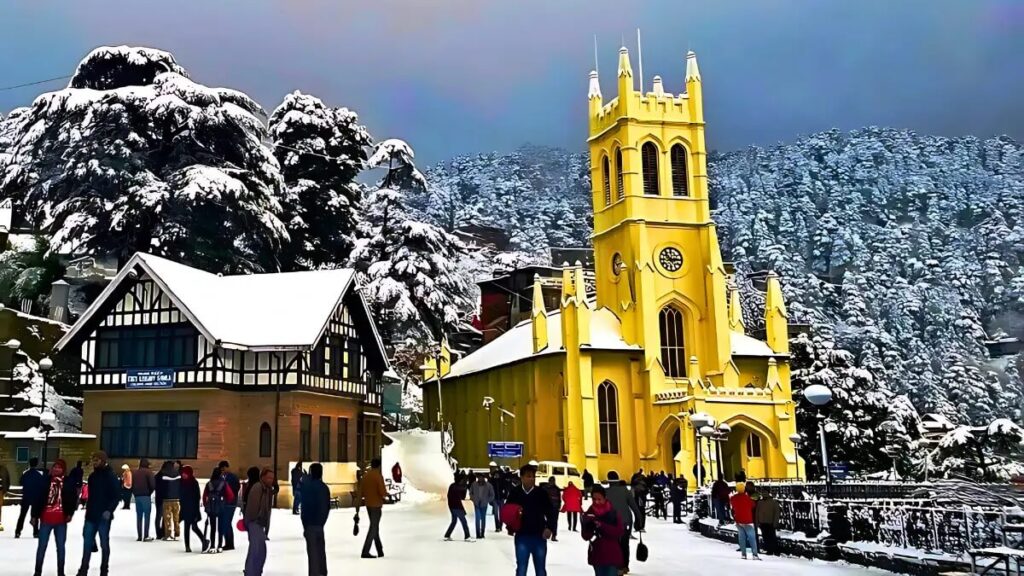
Dalhousie, quieter and less photographed than its two famous neighbours, is having its own understated renaissance. Pine forests, colonial churches, and a noticeably slower pace have made it the pick for travellers who want the hill-station feeling without the hill-station traffic — and its nearby “mini Switzerland,” Khajjiar, gives it a genuine day-trip drawcard of its own. It’s the kind of place that rewards travellers willing to skip the obvious name for the quieter one next door.
A short itinerary worth stealing: Seven nights, eight days across all three — Shimla’s Ridge and Mall Road, a drive to Manali for Old Manali’s café culture and Solang Valley’s activities, then onward to Dalhousie for Khajjiar and a slower final few days among the pines. Budget roughly ₹32,000–₹44,000 per couple across the full circuit, excluding flights or train travel to the region; early booking has reportedly shaved 15–20% off standard peak rates.
Vaishno Devi and Amarnath: Faith on Two Very Different Clocks
No feature on North India’s travel patterns is complete — or honest — without separating these two pilgrimages properly, because they’re frequently spoken of together and they really shouldn’t be.
Vaishno Devi runs on a forgiving calendar. It’s accessible through most of the year, with its clearest peaks falling between March and June, and again around Navratri in October. Families routinely fold it into a wider Jammu-Kashmir circuit precisely because it doesn’t demand rigid timing.
Amarnath allows for none of that flexibility. The Shri Amarnathji Shrine Board has confirmed the 2026 yatra for July 3 through August 28 — a fixed, 57-day window that exists solely because that’s the narrow stretch when the high-altitude cave route is actually passable. Registration and the mandatory medical certificate open months ahead, and there’s no “we’ll go next month” fallback if a family misses the window. There’s only next year.
A short itinerary worth stealing: Four nights, five days for Vaishno Devi — arrival and rest in Jammu, the trek or pony/palki ascent from Katra to the Bhawan, darshan, the descent, and a final day at Jammu’s forts and temples. Budget roughly ₹9,000–₹15,000 per person for stay, transfers, and basic trek assistance, excluding travel to Jammu; a helicopter leg typically adds ₹3,000–₹5,000 one-way.
The Thread Running Through All of It
Pull back far enough, and what looks like five unrelated stories — tulip fields, high-altitude honeymoons, pine-forest hideaways, pilgrim trails on two different clocks — starts to read as one connected shift. North India’s mountains haven’t changed. What’s changed is the assumption that you have to choose just one, and just one season, to experience them.
Whether this holds as a lasting pattern or eases back into its old, single-destination rhythm is genuinely an open question — weather, infrastructure, and simple traveller fatigue could all pull it back. But for this season at least, the north isn’t waiting for its moment. It’s already having several, one after another, almost without a gap.
Frequently Asked Questions
Q1. When does the Kashmir Tulip Garden actually bloom in 2026? Generally mid-to-late March through most of April, with the most vivid display in the first two weeks of April. Dates shift slightly year to year with the weather, so confirming closer to travel is worth the effort.
Q2. Are Vaishno Devi and Amarnath open at the same time of year? No. Vaishno Devi is accessible most months, peaking March–June and around October Navratri. Amarnath is strictly seasonal — confirmed for July 3 to August 28, 2026 — because its route is only passable during that window.
Q3. What’s the real travel season for Ladakh? Roughly May through September, dictated entirely by when the high passes to Nubra Valley and Pangong Lake are open.
Q4. Is Dalhousie worth choosing over Shimla or Manali? It depends on what you’re after. Dalhousie trades some of Shimla and Manali’s activity options for a quieter, less crowded pace and genuine pine-forest scenery — a strong pick for travellers prioritising calm over convenience.
Q5. How early should someone register for the Amarnath Yatra? As soon as registration opens, typically months before the actual pilgrimage dates. Given the fixed short season, missing that window generally means waiting a full year.
Q6. Can a Shimla-Manali-Dalhousie circuit realistically be done in one trip? Yes — the three are naturally connected by road, making a combined circuit of about a week both practical and one of the more popular Himachal itineraries this season.
Q7. Is Ladakh only for adventure travellers, or genuinely suitable for a honeymoon? Both, increasingly. Leh-Nubra-Pangong circuits are now commonly booked as honeymoons, though the altitude and acclimatisation requirements mean it suits couples comfortable with a bit of physical demand alongside the romance.
Q8. What’s a realistic budget for combining Vaishno Devi with a Kashmir trip? Expect roughly ₹9,000–₹15,000 per person for the Vaishno Devi leg alone, plus ₹24,000–₹36,000 per couple for a Kashmir circuit — Jammu’s strong connectivity to Srinagar makes combining the two straightforward.
Editorial note on sourcing: Tulip Garden dates and visitor figures, the Amarnath Yatra 2026 schedule (confirmed by the Shri Amarnathji Shrine Board), and Vaishno Devi’s seasonal peak pattern have been checked against current public reporting at the time of writing. Cost ranges and booking-behaviour figures reflect patterns reported by travel operators and should be read as indicative, since actual rates fluctuate with demand and season.